
Open 24/7 · Calls Answered Anytime Watertown (952) 847-3387
Full Time Heating and Cooling · Watertown, MN

Rooftop Unit Replacement: Repair First, Replace When Necessary

24/7 Emergency Service5.0 · 211 Local ReviewsMN License MB792165
Rooftop Unit Replacement: Repair First, Replace When Necessary
NEED HVAC SERVICE?Leave your number. We'll call within one business day.
No obligation. Your information stays private.

Signs Your Rooftop Unit Has Reached the End of Its Service Life

Most rooftop units have a realistic service life of 15 to 20 years under normal conditions with regular maintenance. Some push past that. Some don't reach it. Age alone isn't the deciding factor, but age combined with these conditions usually is. If your unit is throwing frequent refrigerant leaks, the compressor has failed more than once, heat exchanger cracks are confirmed, or you're looking at repair costs that exceed half the cost of a new system, replacement is probably the honest answer. Dirty condenser coils that are deforming from neglect, not just dirty from a missed cleaning, are a related sign that the system has been running hard for too long. We won't tell you to replace a unit that a solid repair can bring back. But we won't send you down a repair path on a system that's going to fail again in 18 months either. You can also request free HVAC second opinions if you've already received a replacement recommendation and want a second look.

How We Weigh Repair Against Replacement on an RTU

The factors worth knowing: the age of your rooftop unit, the estimated repair cost, and how the unit has been running. A 12-year-old unit with a $500 repair is a clear fix. That same 12-year-old unit facing a $600 compressor repair isn't terrible. But a 14-year-old unit with a $450 repair quote that's also running inefficiently, cycling irregularly, and losing refrigerant? The symptoms all point the same direction. We walk through the numbers with you during the diagnostic so you're making a decision based on the actual condition of the equipment, not a sales pitch.

What a Professional Rooftop Unit Replacement Actually Involves

Details below
Swapping a rooftop unit isn't just lifting the old one off and dropping a new one in. The process done correctly covers these steps:

Load Calculation

Before anything is ordered, we verify the replacement unit is sized correctly for the building's actual heating and cooling load. Oversizing is a real problem that shortens equipment life and increases energy costs.
Equipment Selection

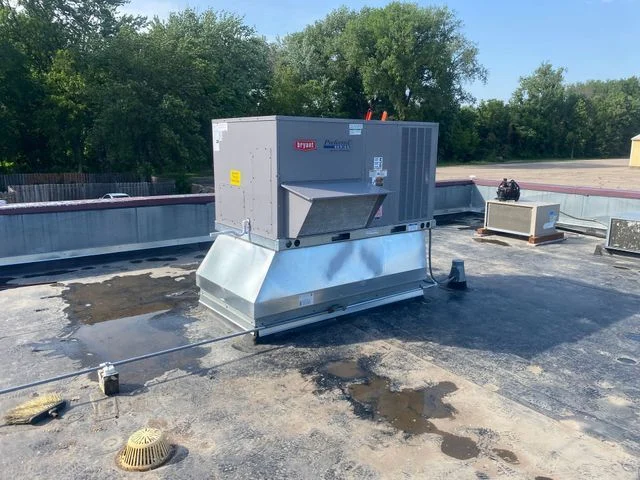
We match the unit to the application, available voltage, refrigerant type, and efficiency requirements. AirQuest rooftop equipment delivers reliable commercial-grade performance without the inflated price of brand-name markup.

Safe Removal of the Existing Unit

Refrigerant is recovered per EPA regulations before the old unit comes off the roof. This isn't optional, and any contractor skipping this step is cutting a corner that creates liability for the building owner.

Roof Penetration and Curb Inspection

We inspect the existing roof curb for damage or improper fit before the new unit is set. A leaking curb connection causes water intrusion that shows up months later as a ceiling problem, not an HVAC problem.

Electrical and Controls Connection

Wiring, thermostat integration, economizer hookup if applicable, and controls verification all happen before the unit is considered commissioned. A unit that starts is not the same as a unit that's properly set up.

Startup and Commissioning

We run the system through heating and cooling modes, verify airflow and refrigerant pressures, and confirm the unit is performing to spec before we're off the roof. Owner Jason inspects every installation at completion.

High-Efficiency Rooftop Units: What the Numbers Actually Mean

Higher efficiency ratings like SEER2 and IEER matter more on a rooftop unit than they do on residential equipment, because commercial systems run longer hours and handle larger loads. An energy-efficient HVAC unit that costs more upfront often pays back the difference in 3 to 5 years through reduced utility costs, particularly in buildings that run heating or cooling 10-plus hours a day. Energy recovery units and ERV air exchangers can be integrated with new rooftop installations to improve ventilation efficiency, reduce heating and cooling loads, and support better indoor air quality without proportionally increasing energy spend. We'll tell you honestly when these additions make financial sense and when they don't. If the building doesn't have the occupancy load or the ventilation demand that justifies an ERV, we won't push one. For buildings where a heat pump system might serve better than a traditional rooftop unit, we'll have that conversation too.

Why We Use AirQuest for Commercial Rooftop Installations

AirQuest isn't the most recognized name in commercial HVAC, and we're not going to pretend otherwise. What it is: dependable equipment built on proven engineering, backed by real warranty coverage, and priced so you're not paying a brand premium for a nameplate. As an AirQuest Elite Dealer, Full Time provides qualifying installations with a 10-year parts limited warranty plus the No Hassle Replacement Limited Warranty, and we add two additional years of No Hassle Replacement coverage on top of that. If a system fails within that window, it gets replaced, not argued about. That's a harder commitment than most commercial HVAC contractors in this market are making. You can read more about why we chose AirQuest and how it affects what you get on installation day.

Rooftop Unit Replacement: Quick Reference

Details below
Key facts for building owners evaluating rooftop unit replacement:

Typical service life

15 to 20 years with regular maintenance. Systems that missed annual tune-ups often fall short of that range.

Replacement cost range

Priced by tonnage, access, and scope. Complex jobs with crane requirements or electrical upgrades push higher.

Decision threshold

Repair cost times unit age over $5,000 generally favors replacement. Confirmed compressor failure on an aging system almost always does.

Warranty coverage

AirQuest Elite installations qualify for 10-year parts warranty plus No Hassle Replacement, with two extra years added through Full Time's Elite Dealer status.

Refrigerant regulations

Systems using R-22 refrigerant cannot be legally recharged with virgin R-22. Replacement is often the only practical path when an R-22 system develops a significant leak.

Emergency availability

Full Time is available 24/7 for rooftop unit emergencies. Commercial buildings losing heating or cooling mid-week don't wait for a Monday appointment.

Schedule a Rooftop Unit Assessment

If your rooftop unit is underperforming, throwing fault codes, or has been quoted for replacement by another contractor, call us before you commit. We'll run an honest diagnostic, give you the repair-versus-replace picture in plain language, and let the numbers make the decision. Full Time Heating and Cooling is fully insured and available 24/7. Call or text (952) 847-3387 to schedule.

Or send us your info

By submitting this form you agree that we may contact you about your request.

FAQ Common questions

Frequently Asked Questions

Answers below
How much does it cost to replace a rooftop unit? +
Rooftop unit replacement is priced by unit tonnage, roof access complexity, crane requirements, electrical modifications, and whether ductwork connections need adjustment. A small single-zone commercial rooftop unit on a flat, accessible roof sits at the low end. A multi-zone system with limited crane access and an electrical panel upgrade costs considerably more. Every job is different, contact Full Time Heating and Cooling for an accurate estimate.
What is the life expectancy of a rooftop unit? +
A well-maintained commercial rooftop unit typically lasts 15 to 20 years. Systems that receive annual tune-ups, have filters changed on schedule, and get coil cleanings regularly tend to hit the top of that range. Units that run without maintenance, or that have been repaired repeatedly for recurring refrigerant leaks or compressor issues, often fall short of 15 years. Roof environment matters too: units on roofs with standing water or poor drainage age faster than those in protected installations.
How much does a rooftop AC unit cost? +
The equipment cost alone for a commercial rooftop AC unit varies with tonnage and efficiency rating. Installation, crane rental, refrigerant charging, controls integration, and any electrical work add to that total. As an AirQuest Elite Dealer, Full Time installs equipment backed by a 10-year parts limited warranty and No Hassle Replacement coverage, with two additional years of No Hassle Replacement coverage on qualifying installations beyond the manufacturer's standard warranty.
When do dirty condenser coils justify replacement rather than cleaning? +
Condenser coils that are dirty from a missed annual cleaning are a maintenance issue, not a replacement trigger. Cleaning them typically restores efficiency and extends the unit's life. But coils that are physically deformed from running in a blocked or restricted state for extended periods, or coils that have developed pin-hole corrosion from exposure, are a different situation. If the coil is leaking refrigerant or structurally compromised, the repair cost often approaches the replacement threshold, especially on older equipment.
Can a rooftop unit be repaired instead of replaced if the compressor has failed? +
Compressor replacement is possible and sometimes the right call. On a unit under 10 years old with no other significant issues, a compressor replacement can extend service life meaningfully. On a unit that's 15 years old, using older refrigerant, and showing signs of heat exchanger wear or coil degradation alongside compressor failure, replacement usually makes more financial sense. We don't have a policy that says compressor failure automatically means replacement. We run the full diagnostic and give you the honest picture.

Our promise

If we can repair it, we will.

No unnecessary replacements.You get the fix, not the invoice we would rather write.

Keep Reading